English
- English
-
 שפה עברית
 -
 繁体中文
繁体中文 -
 Latviešu
 -
 беларускі
 -
 Hrvatski
 -
 lugha ya Kiswahili
 -
 አማርኛ
አማርኛ -
 ქართული
 -
 Hausa
Hausa -
 Zulu
Zulu -
 Հայերեն
 -
 Igbo
Igbo -
 Yoruba
 -
 Español
 -
 Português
 -
 русский
 -
 Français
 -
 日本語
日本語 -
 Deutsch
 -
 tiếng Việt
 -
 Italiano
 -
 Nederlands
 -
 ภาษาไทย
 -
 Polski
 -
 Svenska
 -
 magyar
 -
 Malay
Malay -
 Dansk
Dansk -
 Suomi
Suomi -
 हिन्दी
 -
 Pilipino
 -
 Türkçe
 -
 العربية
 -
 Indonesia
 -
 Norsk
Norsk -
 český
český -
 ελληνικά
 -
 український
 -
 فارسی
فارسی -
 български
 -
 Қазақша
 -
 Azərbaycan
 -
 Slovenský jazyk
 -
 Lietuvos
 -
 Eesti Keel
 -
 Română
 -
 Slovenski
 -
 Srpski језик
 -
 한국어
한국어


Why Do Professional Nail Dryer Lamps Use Both 365nm and 405nm UV LEDs?
In a professional nail salon, the curing lamp is one of the most frequently used tools. Every gel manicure, every extension, and every top coat passes beneath its glow. But not all nail dryer lamps are created equal. A closer look at the professional-grade units reveals a curious design detail: they often use not one, but two distinct wavelengths of UV light—365nm and 405nm. To the untrained eye, this seems redundant. Why not simply use a single, more powerful wavelength? The answer lies in the chemistry of gel nail polish and the physics of light absorption. The photoinitiators that trigger the polymerization of gel polish absorb light most efficiently at specific wavelengths, and no single wavelength is optimal for all formulations.
The dual-wavelength approach is a deliberate engineering solution to a complex problem. It ensures that a wide range of gel products—from hard gels to soft gels, from clear top coats to highly pigmented colors—cure fully and quickly. A Nail Dryer Lamp that uses both 365nm and 405nm LEDs can penetrate deeper into the gel, activate a broader spectrum of photoinitiators, and reduce the risk of under-curing, which can lead to service breakdowns and allergic reactions. At Shenzhen Ruina Optoelectronic Co.,Ltd, our factory has been manufacturing dual-wavelength Nail Dryer Lamp for over a decade, and we have refined the design to optimize curing performance, energy efficiency, and user safety. This article will explore the technical reasons behind the dual-wavelength design, the specific roles of 365nm and 405nm light, and the performance parameters that define a professional-grade lamp.
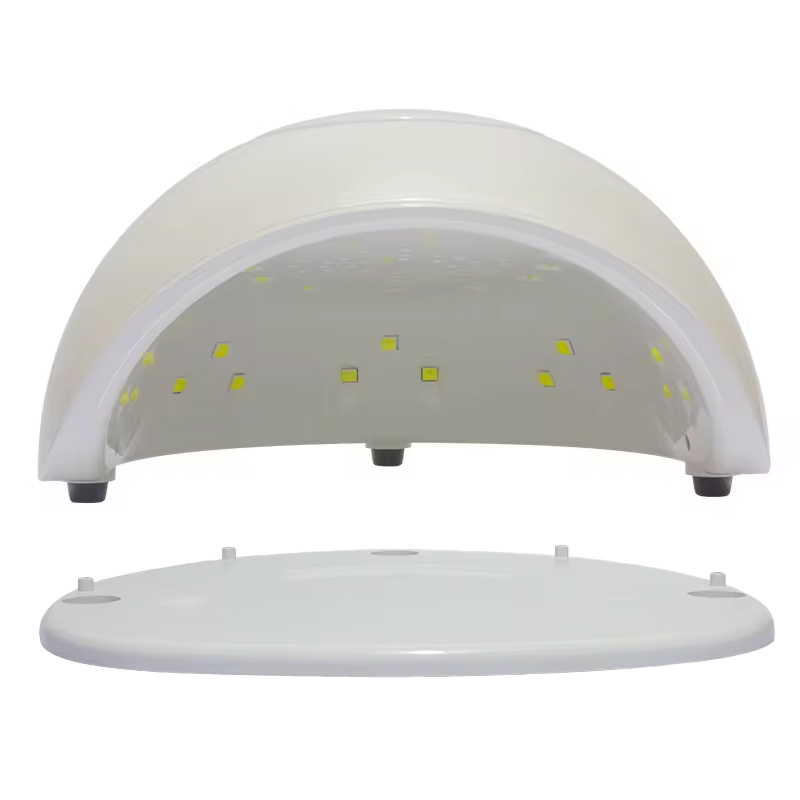
Table of Contents
- 1. What Is the Chemistry Behind Gel Nail Curing?
- 2. Why Does 365nm Light Play a Critical Role in Deep Curing?
- 3. Why Is 405nm Light Essential for Surface Curing and Pigmented Gels?
- 4. How Do Dual-Wavelength Lamps Compare to Single-Wavelength Lamps?
- 5. What Technical Specifications Define a Professional Nail Dryer Lamp?
- 6. Frequently Asked Questions (FAQ)
- 7. Conclusion
1. What Is the Chemistry Behind Gel Nail Curing?
To understand why both 365nm and 405nm LEDs are used in a Nail Dryer Lamp, we must first understand the chemistry of gel nail polish. Gel polish is not a traditional lacquer that dries by evaporation. It is a photopolymer—a liquid resin that hardens when exposed to light of a specific wavelength. The hardening process, known as curing or polymerization, is triggered by molecules called photoinitiators. When a photoinitiator absorbs a photon of light, it enters an excited state and decomposes into reactive species called free radicals. These free radicals attack the acrylate groups in the resin, causing them to link together into a dense, cross-linked polymer network. The result is a hard, durable, and glossy finish that can last for weeks.
The key to effective curing is matching the wavelength of the light source to the absorption spectrum of the photoinitiator. Different photoinitiators absorb light at different wavelengths. Some absorb strongly in the UVA range (315-400nm), while others absorb in the visible violet-blue range (400-420nm). If the light source emits at a wavelength that the photoinitiator does not absorb, the curing reaction will not start, or it will be very slow. Most gel polish formulations use a blend of photoinitiators to achieve a balance of curing speed, depth, and surface finish. This is why a Nail Dryer Lamp with a single wavelength may not fully cure all types of gel polish. The table below lists common photoinitiators and their peak absorption wavelengths.
| Photoinitiator | Peak Absorption Wavelength (nm) | Typical Application |
| Irgacure 184 | 245, 280, 333 | Clear coatings, surface cure |
| Irgacure 819 | 295, 370, 405 | Pigmented gels, deep cure |
| TPO (Trimethylbenzoyl diphenylphosphine oxide) | 295, 368, 405 | Thick sections, pigmented gels |
| DMPA (Dimethoxy phenyl acetophenone) | 250, 340 | Clear gels, surface cure |
| ITX (Isopropyl thioxanthone) | 258, 382 | Photoinitiator for UV LED systems |
The choice of photoinitiator determines the curing characteristics of the gel polish. For a professional Nail Dryer Lamp to be compatible with a wide range of products, it must emit light at the wavelengths that these photoinitiators absorb. This is why dual-wavelength lamps, which emit both 365nm and 405nm light, are preferred. They provide the broad spectral coverage needed to activate the full range of photoinitiators used in modern gel polish formulations.
2. Why Does 365nm Light Play a Critical Role in Deep Curing?
The 365nm wavelength is in the UVA range of the electromagnetic spectrum. It is invisible to the human eye, but it is highly effective at penetrating through the surface of the gel and initiating the curing reaction deep within the layer. This is because 365nm light has a shorter wavelength and higher energy than 405nm light. The higher energy allows it to break the chemical bonds in the photoinitiator more efficiently, generating free radicals that start the polymerization process. The 365nm wavelength is particularly important for curing thick layers of gel, such as those used in hard gel extensions and builder gels. The deep penetration ensures that the entire thickness of the gel is cured, not just the surface.
However, 365nm light has some limitations. It is absorbed strongly by the pigments and UV blockers in colored gels, which means it may not reach the deeper layers of highly pigmented or opaque products. It also has a lower optical power output from LED chips compared to 405nm, which means that more LEDs are required to achieve the same intensity. Additionally, 365nm light is more hazardous to the skin and eyes than 405nm light, so safety measures such as proper shielding and limited exposure times are essential. The table below summarizes the key characteristics of 365nm light in a Nail Dryer Lamp.
| Characteristic | 365nm UV LED |
| Wavelength Range | UVA (315-400nm) |
| Energy per Photon | High (3.4 eV) |
| Curing Depth | Deep (up to 3-5mm in clear gels) |
| Surface Cure | Moderate |
| Pigment Penetration | Poor (blocked by pigments) |
| LED Cost | Higher |
| Safety | Requires careful shielding |
At Shenzhen Ruina Optoelectronic Co.,Ltd, we use high-quality 365nm LED chips in our professional Nail Dryer Lamp. We carefully control the peak wavelength and the spectral bandwidth of the LEDs to ensure that they match the absorption spectrum of the photoinitiators used in professional gel products. We also incorporate advanced thermal management to keep the LEDs cool, ensuring that they maintain their output and lifespan over time.
3. Why Is 405nm Light Essential for Surface Curing and Pigmented Gels?
The 405nm wavelength is at the boundary between the UVA and visible violet light. It is sometimes referred to as "safe" UV because it is less energetic than 365nm and is less likely to cause skin damage. The 405nm wavelength is highly effective at curing the surface of the gel and at penetrating through pigmented gels. The reason is that many of the photoinitiators used in modern gel polishes, such as Irgacure 819 and TPO, have a strong absorption peak around 405nm. This means that 405nm light is very efficient at activating these photoinitiators, even in the presence of pigments that would block shorter wavelengths. This is why 405nm is often called the "surface cure" wavelength.
The 405nm wavelength is also more efficient at generating light output from LED chips. A 405nm LED can produce more optical power than a 365nm LED of the same electrical power, which means that a Nail Dryer Lamp can achieve a higher intensity at 405nm for a given energy consumption. This makes the lamp more energy-efficient and allows for faster curing times. However, 405nm light does not penetrate as deeply as 365nm light, so it is less effective at curing the deepest layers of thick gels. It is for this reason that a dual-wavelength approach is necessary. The 405nm light cures the surface and the pigmented layers, while the 365nm light cures the deeper layers. The table below summarizes the key characteristics of 405nm light in a Nail Dryer Lamp.
| Characteristic | 405nm UV LED |
| Wavelength Range | Visible violet (400-420nm) |
| Energy per Photon | Lower (3.1 eV) |
| Curing Depth | Surface (up to 1-2mm) |
| Surface Cure | Excellent |
| Pigment Penetration | Good (penetrates many pigments) |
| LED Cost | Lower |
| Safety | Lower risk than 365nm |
At our factory, we use a combination of 365nm and 405nm LEDs in our Nail Dryer Lamp to achieve the optimal curing performance. Our engineering team has conducted extensive testing to determine the optimal ratio of 365nm to 405nm LEDs for different types of gel products. We have found that a ratio of approximately 1:2 (365nm:405nm) provides the best balance of deep cure and surface cure for most professional gel polishes. This ratio can be adjusted for specific customer requirements.
4. How Do Dual-Wavelength Lamps Compare to Single-Wavelength Lamps?
The advantages of a dual-wavelength Nail Dryer Lamp over a single-wavelength lamp are significant and measurable. A single-wavelength lamp, typically emitting at either 365nm or 405nm, can only efficiently cure gel polishes that use photoinitiators that absorb at that specific wavelength. This limits the range of products that can be used with the lamp and increases the risk of under-curing. A dual-wavelength lamp, by contrast, emits light at both 365nm and 405nm, providing broad spectral coverage that is compatible with virtually all gel polish formulations. This versatility is essential for professional nail technicians who use a variety of products from different brands. The table below compares the performance of single-wavelength and dual-wavelength lamps.
| Performance Metric | Single-Wavelength (365nm) | Single-Wavelength (405nm) | Dual-Wavelength (365nm + 405nm) |
| Compatibility with Gel Polishes | Limited (clear and thin gels) | Limited (pigmented and surface gels) | Broad (all types of gels) |
| Deep Cure Performance | Excellent | Fair | Excellent |
| Surface Cure Performance | Fair | Excellent | Excellent |
| Curing Time (Typical) | 60-90 seconds | 30-60 seconds | 30-60 seconds |
| Risk of Under-Curing | Moderate to High | Moderate | Low |
| Energy Efficiency | Lower | Higher | Optimized |
| Cost | Medium | Low | Medium-High |
The data clearly shows that the dual-wavelength approach offers the best overall performance. It provides the deep cure of 365nm and the surface cure of 405nm, ensuring that the gel is fully cured from top to bottom. This reduces the risk of service breakdowns, such as chipping, peeling, and lifting, which are often caused by under-curing. It also reduces the risk of allergic reactions, as under-cured gel contains unreacted monomers that can sensitize the skin. At Shenzhen Ruina Optoelectronic Co.,Ltd, our dual-wavelength Nail Dryer Lamp are designed to deliver the highest level of curing performance for professional nail technicians.
5. What Technical Specifications Define a Professional Nail Dryer Lamp?
To ensure that a Nail Dryer Lamp delivers the performance required for professional use, it must meet a set of technical specifications. These specifications cover the light source, the power output, the curing area, the control system, and the safety features. When evaluating a Nail Dryer Lamp for professional use, these are the parameters that should be carefully considered. At our factory, we design our lamps to meet or exceed these specifications, ensuring that our customers get the best possible performance and reliability.
Wavelength Combination: The lamp should emit both 365nm and 405nm light. The ratio of the two wavelengths should be optimized for the types of gel products being used. Our standard configuration uses a 1:2 ratio of 365nm to 405nm LEDs.
Power Output (Irradiance): The irradiance, measured in mW/cm², determines the curing speed. Professional lamps typically have an irradiance of 60-120 mW/cm². Higher irradiance means faster curing, but it can also generate more heat, which can be uncomfortable for the client. Our lamps use a high-efficiency LED array with a total power output of 48-72 watts.
Curing Area: The curing area must be large enough to accommodate all five fingers and the thumb. The typical curing area is 150-200mm wide. Some lamps have a removable bottom plate to allow for curing of pedicures.
Control System: The lamp should have multiple timer settings (e.g., 30s, 60s, 90s) and a low-heat mode for sensitive clients. A motion sensor can automatically turn the lamp on and off, improving convenience and hygiene.
Safety Features: The lamp should have a reflective interior to maximize light exposure and reduce the amount of UV light that escapes. It should also have a thermal protection system to prevent overheating. The LEDs should be of a high quality and should not emit harmful wavelengths outside the UVA range.
The table below provides a summary of the key technical specifications for our professional Nail Dryer Lamp models.
| Specification | Model RN-48 | Model RN-72 | Model RN-96 |
| Wavelength | 365nm + 405nm | 365nm + 405nm | 365nm + 405nm |
| LED Quantity | 48 LEDs | 72 LEDs | 96 LEDs |
| Total Power | 48 W | 72 W | 96 W |
| Irradiance | 60-80 mW/cm² | 80-100 mW/cm² | 100-120 mW/cm² |
| Timer Settings | 30s, 60s, 90s | 30s, 60s, 90s, 120s | 30s, 60s, 90s, 120s |
| Motion Sensor | Yes | Yes | Yes |
| Curing Area (mm) | 170 x 80 | 190 x 90 | 210 x 100 |
| Low Heat Mode | Yes | Yes | Yes |
Our factory at Shenzhen Ruina Optoelectronic Co.,Ltd uses high-quality LED chips and advanced manufacturing processes to ensure that our lamps meet these specifications. We also conduct rigorous testing on every lamp before it is shipped, including irradiance measurement, wavelength verification, and thermal performance testing.
6. Frequently Asked Questions (FAQ)
Question 1: Why can't I just use a 405nm lamp for all gel polishes?
Answer: A 405nm lamp is effective for curing the surface and pigmented layers of most gel polishes. However, 405nm light does not penetrate as deeply as 365nm light. For thick gels, such as hard gels and builder gels, the deeper layers may not receive enough light to cure fully. This can lead to under-curing, which can cause service breakdowns and allergic reactions. A dual-wavelength lamp ensures that both the surface and the deep layers are fully cured.
Question 2: Is 365nm UV light dangerous for the skin?
Answer: 365nm UV light is in the UVA range, which can penetrate the skin and cause damage with prolonged exposure. However, the exposure time during a typical gel manicure is very short (30-90 seconds), and the intensity is relatively low. Professional Nail Dryer Lamp are designed with safety features, such as reflective interiors and shields, to minimize UV exposure to the skin. As with any UV light source, it is important to follow the manufacturer's instructions and avoid unnecessary exposure.
Question 3: How often should I replace the LEDs in my nail dryer lamp?
Answer: The LEDs in a high-quality Nail Dryer Lamp have a lifespan of 10,000 to 50,000 hours. This means that under normal use, the LEDs will last for several years. However, the output of the LEDs can degrade over time, leading to longer curing times. If you notice that the curing time is increasing or that the gel is not curing properly, it may be time to replace the lamp. Our lamps are designed for long life, and we offer replacement LED modules for our professional models.
Question 4: What is the difference between a 36W and a 48W nail dryer lamp?
Answer: The wattage of a Nail Dryer Lamp refers to the total electrical power consumed by the LEDs. A 48W lamp has more LEDs or higher-power LEDs than a 36W lamp, which means it produces a higher irradiance and cures the gel faster. For professional use, a 48W or higher lamp is recommended for faster curing and better compatibility with a wide range of gel products.
Question 5: Can I use a dual-wavelength nail dryer lamp with all brands of gel polish?
Answer: Yes, a dual-wavelength Nail Dryer Lamp is compatible with virtually all brands of gel polish. The 365nm and 405nm wavelengths cover the absorption spectra of the photoinitiators used in modern gel formulations. This makes the dual-wavelength lamp a versatile tool for professional nail technicians who use products from different brands.
7. Conclusion
The use of both 365nm and 405nm UV LEDs in professional Nail Dryer Lamp is not a marketing gimmick; it is a scientifically grounded design decision. The 365nm wavelength provides the high energy needed for deep curing, while the 405nm wavelength provides efficient surface curing and penetration through pigmented gels. Together, they ensure that a wide range of gel products are fully cured, reducing the risk of service breakdowns and allergic reactions. At Shenzhen Ruina Optoelectronic Co.,Ltd, our factory is dedicated to manufacturing high-performance dual-wavelength Nail Dryer Lamp that meet the demanding requirements of professional nail technicians. We use high-quality components, advanced manufacturing processes, and rigorous testing to ensure that every lamp we produce delivers reliable, consistent curing performance.
If you are looking for a Nail Dryer Lamp that combines deep curing, fast curing, and broad compatibility, our dual-wavelength lamps are the solution. Contact us today to discuss your specific requirements and to request a sample. Our technical team is ready to assist you in selecting the right lamp for your salon or your product line.
Contact Shenzhen Ruina Optoelectronic Co.,Ltd today to learn more about our dual-wavelength Nail Dryer Lamp.
Send Inquiry



X
We use cookies to offer you a better browsing experience, analyze site traffic and personalize content. By using this site, you agree to our use of cookies.
Privacy Policy